The Grand Canyon is more than a vast opening in the Colorado Plateau. Its cliffs preserve evidence of ancient environments, its elevation changes create sharply different ecosystems, and its human history reaches far beyond the establishment of a national park.
The canyon is also a living homeland. Indigenous peoples maintain enduring cultural, spiritual, and historical connections to this landscape, while scientists, educators, artists, residents, and visitors continue to study how its natural and cultural systems interact.
This guide introduces the major subjects that help explain the Grand Canyon. Each section leads to a focused article where the story can be explored in greater depth.
Understanding the Grand Canyon Landscape
Geology
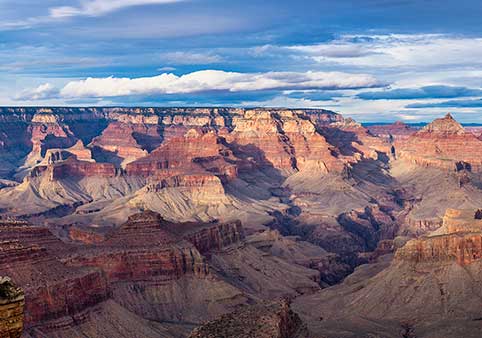
The walls of the Grand Canyon expose an extraordinary record of Earth history. Ancient crystalline rocks appear near the river, while younger sedimentary formations rise in broad layers toward the rims.
These rocks formed in environments that included mountains, coastlines, shallow seas, river systems, deserts, tidal flats, and other landscapes that existed long before the modern canyon. Erosion later exposed this record one layer at a time.
The canyon itself is much younger than many of the rocks visible within it. Uplift, river integration, erosion, tributary drainage, groundwater, faulting, weathering, and landslides all contributed to the landscape seen today. Scientists continue to investigate the timing and sequence of those processes.
Related guides: Grand Canyon Rock Layers » | How the Grand Canyon Formed » | Geologic Time » | Fossils »
The Colorado River
The Colorado River is the central physical thread running through the Grand Canyon. Its flowing water transports sediment, reshapes beaches, cuts into bedrock, influences riparian habitat, and connects distant parts of the Colorado Plateau.
The river does not act alone. Side streams, flash floods, debris flows, springs, groundwater, freezing and thawing, rockfall, and gravity all help widen and reshape the canyon.
Modern dams upstream affect the river's flow, temperature, sediment, and ecology. Understanding the present river therefore requires studying both natural processes and human decisions throughout the Colorado River Basin.
Weather, Climate and Elevation
Elevation is one of the keys to understanding the Grand Canyon. Conditions can shift from cool forests on the rims to hot desert near the Colorado River, even though those environments appear close together on a map.
The North Rim is generally higher and cooler than the South Rim. Far below both rims, the inner canyon receives less shade and can become dramatically hotter. Snow may cover the rim while lower elevations remain comparatively mild.
Seasonal patterns include winter storms, spring winds, intense summer heat, thunderstorms, lightning, flash flooding, and periods of reduced visibility from dust, smoke, or regional air pollution. Climate describes the long-term pattern; weather describes what is happening at a particular place and moment.
Related guides: Grand Canyon Seasons » | Monsoon and Thunderstorms »
Life Across the Canyon
Plants and Ecosystems
The Grand Canyon crosses a remarkable range of elevations, temperatures, soils, moisture levels, slopes, and exposures. These differences create a mosaic of forests, woodlands, shrublands, desert communities, meadows, springs, streams, and riverside habitats.
Spruce, fir, aspen, and mixed-conifer communities occur at higher elevations, particularly on the North Rim. Ponderosa pine forests grow along both rims, while pinyon-juniper woodland occupies many middle elevations. Desert shrubs, cacti, agaves, and drought-adapted plants become more common deeper in the canyon.
Water creates some of the canyon's most biologically important places. Springs, seeps, tributaries, and riparian corridors support concentrated plant life within an otherwise dry landscape.
Wildlife
Grand Canyon wildlife ranges from large mammals and soaring birds to reptiles, amphibians, fish, insects, and tiny organisms living in soil, caves, springs, and streams.
Mule deer, elk, bighorn sheep, coyotes, bats, squirrels, lizards, snakes, ravens, condors, and many other animals occupy different parts of the landscape. Their distribution is shaped by elevation, food, water, shelter, temperature, migration, and human activity.
Wildlife should be observed from a respectful distance. Feeding, approaching, following, or disturbing animals changes their behavior and can endanger both the animal and the observer.
Dark Skies
The Grand Canyon does not disappear after sunset. Darkness reveals a landscape of stars, planets, moonlight, nocturnal wildlife, and changing silhouettes along the rim.
Naturally dark skies are both an educational resource and an ecological one. Artificial light can interfere with wildlife behavior, human night vision, scientific observation, and the experience of seeing a largely unobscured night sky.
Grand Canyon National Park is recognized as an International Dark Sky Park. Protecting that darkness involves using outdoor lighting carefully and reducing unnecessary glare.
Related: Stargazing at the Grand Canyon »
People, Culture and Stewardship
Indigenous Peoples and the Grand Canyon
The Grand Canyon is an ancestral homeland, a sacred landscape, and a living cultural place. Indigenous connections to the canyon did not end when national boundaries, reservations, or a national park were established.
Grand Canyon National Park recognizes 11 contemporary Tribes with historic and cultural connections to the lands and resources now within the park. Each nation has its own history, identity, language, traditions, government, and relationship with the canyon.
No single article can speak for all Indigenous peoples or reduce these relationships to one shared narrative. Whenever possible, GrandCanyon.net should direct readers toward information and perspectives presented by the Tribes themselves.
Use Present-Tense Language
Indigenous peoples are not merely part of the Grand Canyon's past. Tribal communities continue to maintain cultural, spiritual, familial, artistic, ecological, and political relationships with the canyon today.
Related guides: Indigenous People »
Conservation and Change
Protecting the Grand Canyon involves more than preserving a scenic view. Conservation work addresses water, wildlife, native plants, invasive species, fire, air quality, archaeological resources, historic structures, dark skies, visitor impacts, and the health of the Colorado River.
The canyon is not a frozen landscape. Drought, climate change, wildfire, flooding, erosion, development pressures, regional water use, and changing river operations continue to affect its natural and human communities.
Conservation also raises questions about authority, access, stewardship, and whose knowledge guides decisions. Federal agencies, Tribal nations, researchers, nonprofit organizations, residents, visitors, and downstream communities may share concerns while bringing different responsibilities and perspectives.
Related guides: Climate Change » | Protecting the Colorado River »
Continue Exploring GrandCanyon.net
Put this knowledge into geographic context, discover ways to experience the landscape, or explore the wider Colorado Plateau.