Grand Canyon geology tells two connected but very different stories. The rocks exposed within the canyon preserve nearly two billion years of Earth history, while the canyon carved into those rocks is much younger. Understanding that distinction is the key to making sense of the landscape.
The oldest identified rock in the Grand Canyon is approximately 1.84 billion years old. The Kaibab Formation supporting much of the North and South rims was deposited about 270 million years ago. The modern Colorado River and much of the canyon visitors see today developed far more recently, through a complicated history of uplift, river integration, downcutting, tributary erosion, weathering, rockfalls, and floods.
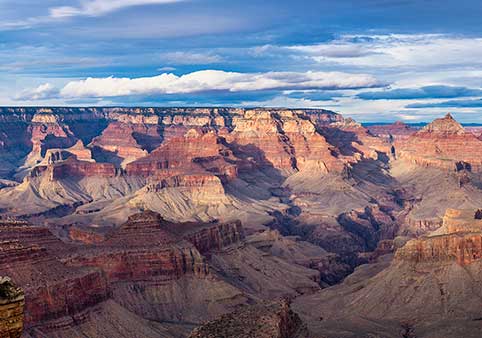
Visitors do not need to memorize every formation to understand the canyon. Begin with the larger pattern: ancient crystalline rocks appear near the river, younger sedimentary layers form the cliffs and slopes above them, and erosion has exposed this history one chapter at a time.
The Essential Idea
The Grand Canyon is not nearly two billion years old. Some of the rocks exposed within it are nearly two billion years old. The canyon was carved much later into an already ancient landscape.
Why Is Grand Canyon Geology So Important?
The Grand Canyon is one of the world’s most important geological landscapes because it exposes an unusually long and varied rock record within a single immense view. From the rim, visitors can see rocks that formed in ancient seas, coastal plains, river systems, deserts, volcanic settings, and deep mountain roots.
The canyon also reveals many of the processes that shape Earth’s surface. Deposition created the rock layers. Tectonic activity folded, faulted, and uplifted parts of the region. The Colorado River cut downward, while tributaries, groundwater, weather, and gravity widened and reshaped the canyon.
Few places make those processes so visible to non-geologists. A visitor can stand at an overlook, walk the Trail of Time, examine exhibits at Yavapai Geology Museum, or descend toward the river and see progressively older rocks appear below.
Grand Canyon Geology at a Glance
| Geological Feature | What Visitors Should Know |
|---|---|
| Oldest identified rock | The Elves Chasm Gneiss is approximately 1.84 billion years old. |
| Youngest major rim layer | The Kaibab Formation was deposited about 270 million years ago. |
| Age of the modern canyon | Much younger than its rocks; major development of the integrated river system occurred during the past several million years. |
| Regional setting | The canyon is carved into the uplifted Colorado Plateau. |
| Primary downcutting force | The Colorado River and its sediment load. |
| Major widening forces | Tributaries, weathering, groundwater, floods, rockfalls, landslides, and gravity. |
| Most visible pattern | Resistant rocks form cliffs, while softer rocks form slopes and terraces. |
| Best interpretive area | Yavapai Point, Yavapai Geology Museum, and the Trail of Time. |
How Old Is the Grand Canyon?
There is no single age that describes every part of the Grand Canyon. Some ancient landscapes and drainage systems may have influenced its development before the modern Colorado River became established, and scientists continue studying the timing and sequence of those events.
The present Colorado River system through the canyon is generally associated with events during the past five to six million years. Recent research continues refining how the river became connected across the region, including the possible role of ancestral river systems, tectonic changes, and spillover from prehistoric lakes.
That ongoing research does not change the most useful visitor takeaway: the canyon is far younger than the rocks in its walls. A rock layer may have existed for hundreds of millions of years before the Colorado River exposed it.
Why Is the Grand Canyon Still Scientifically Important?
The Grand Canyon is not a solved geological puzzle with every event placed neatly on a timeline. Researchers continue examining when different canyon segments formed, how the river became integrated, how uplift varied across the plateau, and how faults, groundwater, volcanism, and climate influenced erosion.
This uncertainty is part of good science. New dating methods, field observations, river deposits, cave records, volcanic rocks, and sediment studies allow scientists to test older explanations and develop better ones.
While You’re Here, Notice...
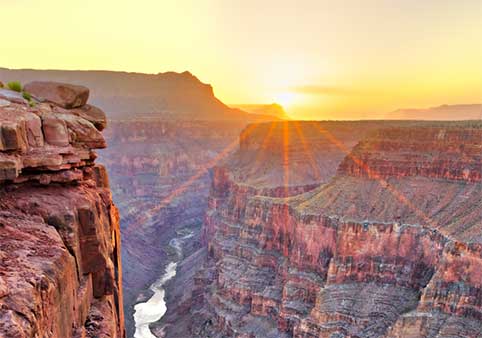
Look beyond the canyon’s size and color. Notice the repeated cliffs, slopes, terraces, faults, side canyons, and dark Inner Gorge. Each shape reflects a different part of the geological story.
How Can You Read the Grand Canyon’s Geological Story?
The easiest way to read the Grand Canyon is from top to bottom. Younger sedimentary rocks form much of the rim and upper walls. Older sedimentary and volcanic rocks appear lower in portions of the canyon, followed by ancient metamorphic and igneous rocks near the Colorado River.
The sequence is not complete. Enormous spans of time are missing where erosion removed older landscapes or where no sediment accumulated. Those missing chapters are called unconformities.
The Three Major Sets of Grand Canyon Rocks
The canyon’s rocks can be organized into three broad groups. This framework is more useful for first-time visitors than trying to memorize dozens of formation names.
| Rock Group | Where It Appears | What It Records |
|---|---|---|
| Vishnu Basement Rocks | Deep in the Inner Gorge near the Colorado River | Ancient metamorphic rocks and later igneous intrusions formed deep within Earth’s crust. |
| Grand Canyon Supergroup | Best exposed in portions of the eastern canyon | Sedimentary and volcanic rocks deposited in fault-bounded basins, later tilted and eroded. |
| Layered Paleozoic Rocks | Most of the familiar cliffs and slopes between the rim and Inner Gorge | Ancient seas, beaches, tidal flats, coastal plains, rivers, and deserts. |
The Vishnu Basement Rocks are not one simple layer. They include intensely altered metamorphic rocks and igneous bodies that record mountain-building events nearly two billion years ago.
The Grand Canyon Supergroup ranges from approximately 1.25 billion to 729 million years old. Many of these formations were tilted before younger, flatter rocks accumulated above them.
The layered Paleozoic rocks include the formations most visitors recognize, such as the Kaibab Formation, Coconino Sandstone, Hermit Formation, Supai Group, Redwall Limestone, Bright Angel Shale, and Tapeats Sandstone.
How Did the Grand Canyon Form?
No single event created the Grand Canyon. Its formation required several major geological stages working together across immense spans of time.
| Stage | What Happened |
|---|---|
| Ancient rock formation | Mountain building, metamorphism, and magma formed the oldest basement rocks. |
| Sediment deposition | Seas, rivers, coastal plains, and deserts deposited younger layers over hundreds of millions of years. |
| Uplift | The Colorado Plateau rose thousands of feet while many rock layers remained comparatively horizontal. |
| River integration and downcutting | The Colorado River became connected through the region and cut downward into the elevated plateau. |
| Canyon widening | Tributaries, floods, weathering, groundwater, landslides, rockfalls, and gravity enlarged the canyon. |
| Ongoing change | Erosion, debris flows, river transport, fault movement, and weather continue reshaping the landscape. |
The Colorado River is central to the canyon’s depth because it transports broken rock and sediment away from the landscape. But the river alone did not create the canyon’s enormous width. Side streams cut tributary canyons, groundwater weakened slopes, and gravity pulled fractured rock downward.
Why Do Some Rocks Form Cliffs and Others Form Slopes?
The canyon’s staircase-like profile results largely from differential erosion. Harder rocks resist erosion and commonly form cliffs or ledges. Softer rocks break down more readily and form slopes.
When a softer formation erodes beneath a resistant one, the harder rock eventually loses support. Blocks fracture and fall, causing the cliff to retreat. This repeating process creates many of the alternating cliffs, slopes, and terraces visible from the rim.
| If You See... | You May Be Looking At... |
|---|---|
| Light-colored rock forming the rim | Kaibab Formation |
| Prominent pale cliff below the upper slopes | Coconino Sandstone |
| Broad reddish slopes beneath the Coconino | Hermit Formation and portions of the Supai Group |
| Massive reddish cliff in the middle canyon | Redwall Limestone, stained red by material from formations above |
| Greenish or gray slope above the lowest broad cliff | Bright Angel Shale |
| Dark, steep-walled gorge near the river | Vishnu Basement Rocks |
Why Are the Rocks Different Colors?
Rock color reflects mineral content, surface staining, oxidation, weathering, moisture, vegetation, shadow, and reflected light. Iron-bearing minerals contribute many of the canyon’s red, orange, and brown tones, but color alone is not always a reliable way to identify a formation.
Redwall Limestone provides a useful example. Despite its name, the limestone itself is generally gray. Its familiar red appearance comes largely from iron-rich material washing down from formations above and staining the cliff face.
What Is the Great Unconformity?
An unconformity is a gap in the rock record representing time when sediment was not deposited or when previously formed rocks were removed by erosion. The Grand Canyon contains several major unconformities rather than one universally identical boundary.
The best-known examples occur where much younger sedimentary rocks rest above ancient basement rocks or tilted Grand Canyon Supergroup formations. In places, more than one billion years of geological history are absent.
The missing time is not an empty mystery. It records long intervals of uplift, erosion, tectonic change, and landscape development that occurred before new sediments accumulated.
Are There Fossils in the Grand Canyon?
Yes. Many sedimentary formations preserve fossils and trace fossils that reveal ancient marine and terrestrial environments. These include shells, corals, brachiopods, crinoids, burrows, tracks, and other evidence of past life.
Dinosaur fossils are not prominent in the canyon walls because most of the exposed sedimentary sequence predates dinosaurs. Younger rocks once existed above the present rims but were largely removed by erosion.
Rocks and fossils are protected within Grand Canyon National Park and must remain where they are found.
Where Can Visitors Best Experience Grand Canyon Geology?
Geology becomes easier to understand when the explanation is connected to a real view. The South Rim offers several locations where exhibits, trails, and overlooks help visitors recognize formations and geological processes without hiking deep into the canyon.
Best Places to Learn About the Geology
| Location | Why It Is Useful |
|---|---|
| Yavapai Geology Museum | Panoramic windows, models, rock samples, and exhibits connect geological explanations directly to the canyon. |
| Yavapai Point | Broad central-canyon views make it easier to compare upper sedimentary layers with the Inner Gorge. |
| Trail of Time | An outdoor timeline helps visitors visualize the immense age of the canyon’s rocks. |
| Moran Point | Colorful formations, tilted Supergroup rocks, and changing light reveal several geological stories at once. |
| Lipan Point | Long views of the Colorado River and eastern canyon reveal the relationship between river incision and layered rock. |
| Grandview Point | A broad panorama shows how cliffs, slopes, side canyons, and isolated formations fit together. |
| South Kaibab Trail | Descending below the rim allows hikers to move physically through progressively older formations. |
A Simple Geology Experience for First-Time Visitors
Begin at Yavapai Point
Look across the central canyon and identify the pale rim, alternating cliffs and slopes, and dark Inner Gorge.
Visit Yavapai Geology Museum
Use the exhibits and panoramic windows to connect formation names and processes with the real landscape.
Walk Part of the Trail of Time
Let distance represent geological time and examine rock samples along the Rim Trail.
Continue to Moran or Lipan Point
Compare the central canyon with the eastern canyon, where tilted rocks and long river views reveal additional parts of the story.
Look Again at Sunset or Late Afternoon
Low-angle light creates shadows that make cliffs, slopes, faults, and side canyons easier to distinguish.
Common Grand Canyon Geology Myths
| Common Myth | What the Evidence Shows |
|---|---|
| The Grand Canyon is nearly two billion years old. | Some exposed rocks are nearly two billion years old, but the canyon is much younger. |
| The Colorado River created the canyon by itself. | The river cut downward, while tributaries, weathering, groundwater, floods, landslides, and gravity widened it. |
| Every visible layer formed one after another without interruption. | Major unconformities represent long periods of missing time, erosion, and non-deposition. |
| All red rock is naturally red throughout. | Some formations, including Redwall Limestone, receive much of their color from surface staining. |
| The canyon is no longer changing. | Floods, rockfalls, weathering, erosion, debris flows, and river transport continue reshaping it. |
| Dinosaur fossils should be common. | Most rocks exposed in the main canyon walls are older than dinosaurs. |
Frequently Asked Questions About Grand Canyon Geology
How old are the oldest rocks in the Grand Canyon?
The oldest identified rock is the Elves Chasm Gneiss, dated to approximately 1.84 billion years ago. Other ancient metamorphic and igneous rocks are exposed throughout portions of the Inner Gorge.
Is the Grand Canyon two billion years old?
No. Some rocks exposed within it are nearly two billion years old, but the canyon itself formed much later.
How old is the Grand Canyon itself?
The modern Colorado River system and much of the canyon’s present form developed during the past several million years. Scientists continue researching the timing and contribution of older canyon segments and drainage systems.
Did the Colorado River create the Grand Canyon?
The river was the primary force cutting downward and transporting sediment, but tributaries, groundwater, weathering, floods, rockfalls, landslides, and gravity also played essential roles.
Why are the Grand Canyon rock layers different colors?
Colors reflect mineral content, iron oxidation, surface staining, moisture, weathering, vegetation, and changing light. Color by itself is not always enough to identify a formation.
Why do some layers form cliffs and others form slopes?
Harder rocks resist erosion and commonly form cliffs, while softer rocks weather more easily and form slopes. This pattern is known as differential erosion.
What is the youngest major rock layer at the rim?
The Kaibab Formation supports much of the North and South rims and was deposited approximately 270 million years ago.
Where can visitors see the oldest rocks?
The oldest rocks appear in the Inner Gorge near the Colorado River. From the rim, they can be recognized as dark, steep-walled rock deep below many overlooks.
What is the Great Unconformity?
The term refers to major gaps in the geological record where younger rocks rest above much older rocks after long periods of erosion or non-deposition. Grand Canyon contains several important unconformities.
Are dinosaur fossils found in the Grand Canyon?
Dinosaur fossils are not a major feature of the exposed canyon walls because most visible formations predate dinosaurs. Younger rocks that could have preserved them were largely removed from above the rims.
Is the Grand Canyon still changing?
Yes. Erosion, rockfalls, debris flows, floods, weathering, river transport, and tectonic activity continue changing the canyon, although many changes occur slowly on human timescales.
Can visitors collect rocks or fossils?
No. Rocks, fossils, archaeological materials, plants, and other natural objects are protected within Grand Canyon National Park and should remain where they are found.
Continue Exploring Nature & Science
Grand Canyon geology becomes easier to understand when the rock record, canyon formation, river, faults, fossils, and regional landscape are explored together.
Faults and Grand Canyon Landforms »