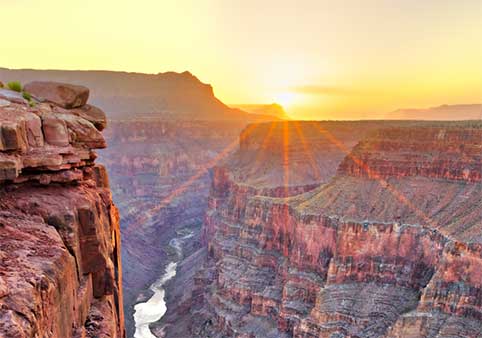
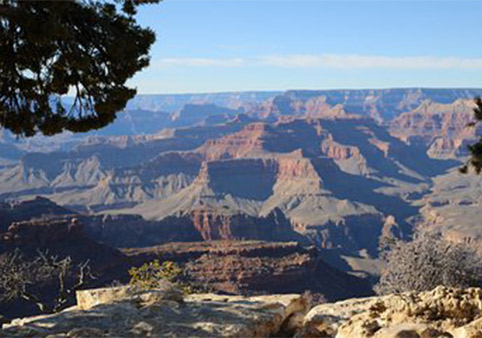
Few places on Earth allow visitors to travel through as much of our planet's history as the Grand Canyon. Standing on the South Rim, you're looking across nearly two billion years of geological time preserved within the canyon walls. Every cliff, slope, and rock layer represents a different chapter in Earth's story, from ancient mountain-building events to shallow tropical seas and vast desert sand dunes.
Understanding the Grand Canyon begins with understanding geologic time. Unlike human history, which spans thousands of years, geology measures time in millions and billions of years. The oldest rocks exposed in the canyon formed long before plants or animals lived on land, while the canyon itself is surprisingly young compared to the rocks it exposes.
One of the most remarkable aspects of the Grand Canyon is that hiking deeper into the canyon is also a journey backward through time. Every major trail descends through progressively older rock formations, allowing visitors to experience hundreds of millions of years of Earth's history in just a few miles.
This guide explains how geologists divide Earth's history, why the Grand Canyon is one of the world's greatest geological records, and how its rock layers preserve nearly two billion years of changing environments.
Understanding Deep Time
The immense ages associated with the Grand Canyon can be difficult to imagine. Humans naturally think in terms of years, decades, or centuries, but geology deals with timescales so vast that they reshape entire continents. Learning to think in "deep time" helps explain why the canyon looks the way it does today.
What Is Geologic Time?
Geologic time is the timeline scientists use to describe Earth's 4.54-billion-year history. Instead of centuries or millennia, geologists divide time into eons, eras, periods, and epochs based on major changes in Earth's rocks, climate, and life.
Most of the rock layers visible in the Grand Canyon were deposited during the Paleozoic Era, between about 525 and 270 million years ago. These formations record ancient seas, coastal plains, river systems, and deserts that existed long before dinosaurs appeared.
The dark metamorphic rocks exposed along the Colorado River are much older still. Known collectively as the Vishnu Basement Rocks, they formed nearly two billion years ago and preserve evidence of some of the earliest mountain-building events in North America.
Why the Grand Canyon Is a Geological Time Capsule
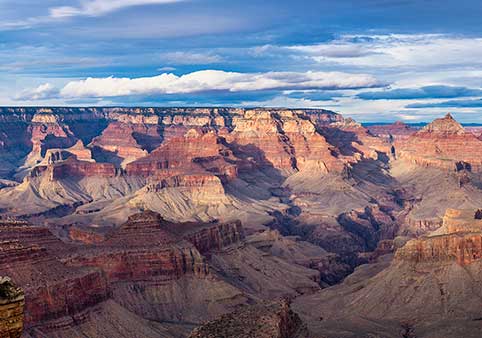
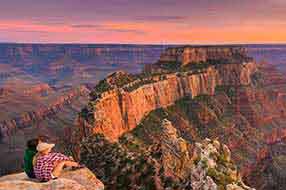
Many places contain ancient rocks, but few expose them as clearly as the Grand Canyon. Rather than being hidden beneath forests, soil, or younger sediments, the canyon's rock layers are displayed like the pages of an enormous history book.
Each formation represents a different environment that once existed here. Some formed beneath warm tropical seas filled with marine life, while others preserve the remains of ancient beaches, muddy floodplains, or towering desert sand dunes. Together they provide one of the world's most complete records of changing environments through time.
Because erosion sliced deeply into the Colorado Plateau, geologists can study rocks that would normally remain buried thousands of feet below the surface.
Rocks Are Older Than the Canyon
One of the most important concepts in Grand Canyon geology is that the rocks are far older than the canyon itself. Visitors often hear that the canyon is nearly two billion years old, but that number refers to the age of its oldest exposed rocks, not to the canyon.
Most of the visible rock layers formed between 525 and 270 million years ago. The canyon itself was carved much later, primarily during the past five to six million years after the Colorado River became established across the uplifted Colorado Plateau.
In other words, the Grand Canyon is like a window into Earth's past. The rocks record ancient history, while the canyon is the opening that allows us to see it.
Two Billion Years of History
The story preserved within the Grand Canyon spans nearly half of Earth's existence. While many chapters have been erased by erosion, the rocks that remain tell an extraordinary story of changing landscapes over almost two billion years.
1.8 Billion Years Ago: Building the Foundation
The oldest rocks exposed within the canyon formed between approximately 1.7 and 1.8 billion years ago. These metamorphic and igneous rocks originated deep beneath ancient mountain ranges where intense heat and pressure transformed older volcanic and sedimentary rocks.
Today these ancient formations are collectively known as the Vishnu Basement Rocks. They are visible primarily within the Inner Gorge, where the Colorado River has cut through every younger layer above them.
Although these rocks formed nearly two billion years ago, they did not become visible until millions of years of erosion removed the younger formations that once covered them.
1.25 Billion to 730 Million Years Ago: A Different Grand Canyon
Much later, rivers, shallow seas, and volcanic activity deposited the rocks now known as the Grand Canyon Supergroup. These formations accumulated over hundreds of millions of years before tectonic forces tilted them dramatically.
Unlike the nearly horizontal Paleozoic rock layers above them, the Supergroup rocks stand at noticeable angles because they were deformed long before the modern canyon began to form.
Large portions of the Supergroup were later eroded away, creating one of the canyon's most significant gaps in the geological record.
525 to 270 Million Years Ago: Ancient Seas, Beaches, and Deserts
Beginning about 525 million years ago, northern Arizona became a landscape of constantly changing environments. Over the next 250 million years, shallow seas repeatedly advanced and retreated across the region, rivers crossed broad coastal plains, and vast deserts spread across the continent. Each environment left behind a different layer of sediment that eventually hardened into rock.
The oldest Paleozoic rocks exposed in the Grand Canyon are the Tapeats Sandstone, Bright Angel Shale, and Muav Limestone, collectively known as the Tonto Group. These formations record the advance of an ancient sea across the continent during the Cambrian Period.
Later, tropical oceans deposited the massive Redwall Limestone, while changing coastlines and river systems created the colorful formations of the Supai Group. Eventually, one of North America's largest ancient sand dune fields produced the bright cliffs of the Coconino Sandstone before shallow seas returned once again to form the Kaibab Formation that caps today's canyon rims.
Together, these rock layers preserve nearly 250 million years of changing environments, making the Grand Canyon one of the world's finest records of Paleozoic geology.
70 to 40 Million Years Ago: The Colorado Plateau Rises
After the youngest rock layers had been deposited, the region entered another major chapter of its history. During the Laramide Orogeny, powerful tectonic forces slowly lifted much of the western United States. Instead of crumpling into steep mountain ranges, the Colorado Plateau rose thousands of feet while remaining remarkably intact.
This uplift fundamentally changed the landscape. Rivers flowing across the plateau now had a much steeper descent toward the Pacific Ocean, giving them greater energy to erode downward into the rock.
Without this uplift, the Colorado River would never have had enough elevation change to carve a canyon more than a mile deep.
5 to 6 Million Years Ago: The Colorado River Connects
Although rivers had existed in the region for millions of years, today's Colorado River developed only after several ancient drainage systems became connected. Once a continuous river flowed across the uplifted Colorado Plateau toward the Gulf of California, it began cutting rapidly into the landscape.
As the river removed sediment from its channel, weathering and gravity widened the canyon from above. Side canyons formed as tributary streams carved their own valleys, eventually creating the intricate network of cliffs, mesas, buttes, and gorges visible today.
Most geologists agree that much of the modern Grand Canyon developed during this period, although some sections may preserve evidence of older ancestral canyons that predate the modern Colorado River.
Today: A Canyon Still Evolving
The Grand Canyon is often thought of as an ancient, unchanging landscape, but it remains remarkably active. Every year, storms trigger flash floods, freeze-thaw cycles loosen rocks from towering cliffs, and the Colorado River continues transporting sediment downstream.
Although the canyon changes slowly from a human perspective, geological processes never truly stop. Rockfalls reshape cliffs, tributaries deepen side canyons, and erosion gradually exposes new sections of Earth's history.
The canyon visitors see today is simply the latest chapter in an ongoing story that began nearly two billion years ago and will continue long into the future.
Seeing Time in the Canyon
One of the most remarkable aspects of the Grand Canyon is that visitors can experience deep time without specialized equipment or scientific training. Every overlook and hiking trail provides clues to events that occurred across hundreds of millions of years.
Walking Back Through Time
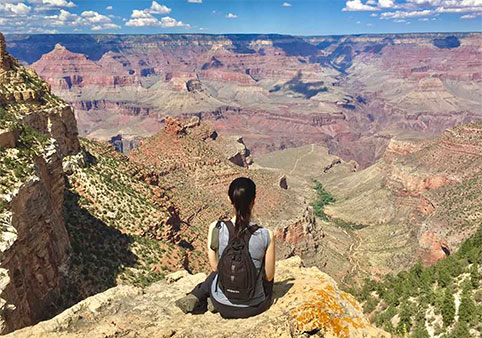
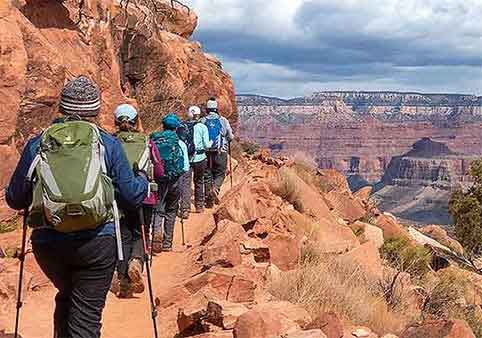
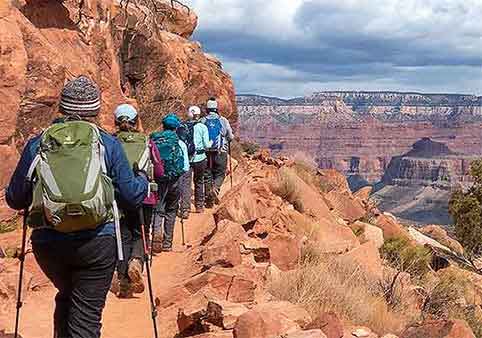
Descending into the Grand Canyon is unlike hiking almost anywhere else in the world. Instead of climbing toward younger rocks, hikers travel deeper into progressively older formations. A walk from the South Rim to the Colorado River is also a journey backward through more than a billion years of Earth's history.
Each switchback crosses another chapter in the geological record. Massive limestone cliffs give way to ancient desert sand dunes, floodplain mudstones, shallow marine deposits, and finally the metamorphic basement rocks that formed deep beneath ancient mountain ranges.
Missing Chapters
The canyon preserves an extraordinary geological record, but it is not complete. Several enormous gaps, known as unconformities, represent periods when erosion removed previously deposited rocks or when no new sediments accumulated.
The most famous example, the Great Unconformity, separates the Cambrian Tapeats Sandstone from much older rocks below. In some locations, more than one billion years of Earth's history are missing across this single boundary.
These missing chapters are just as important to geologists as the rocks that remain because they reveal times when landscapes were being eroded rather than built.
A Living Geological Laboratory
The Grand Canyon continues to serve as one of the world's most important outdoor geology classrooms. Scientists study its rocks to understand ancient climates, changing sea levels, tectonic forces, mountain building, erosion, and the evolution of life on Earth.
Because the canyon exposes so much of Earth's history in one location, it remains an invaluable natural laboratory for researchers while giving millions of visitors an opportunity to witness deep time firsthand.
Frequently Asked Questions
How old are the oldest rocks in the Grand Canyon?
The oldest exposed rocks are the Vishnu Basement Rocks, which formed approximately 1.7 to 1.8 billion years ago. These metamorphic and igneous rocks are visible within the Inner Gorge near the Colorado River and represent the geological foundation of the canyon.
How old is the Grand Canyon itself?
Although the canyon exposes rocks nearly two billion years old, the modern Grand Canyon is much younger. Most geologists agree that much of the canyon was carved during the past five to six million years after the Colorado River became fully integrated across the uplifted Colorado Plateau.
Why are the rocks older than the canyon?
The rock layers formed long before the canyon existed. Ancient seas, deserts, rivers, and floodplains deposited sediments over hundreds of millions of years. Much later, the Colorado Plateau rose, allowing the Colorado River and other erosional processes to carve through those already-existing rocks.
What is deep time?
Deep time is the concept of Earth's immense geological history, spanning billions of years. It helps scientists understand processes that occur far too slowly to observe within a human lifetime, including mountain building, erosion, and the formation of continents.
What is the Great Unconformity?
The Great Unconformity is one of the Grand Canyon's most significant geological boundaries. In many places, the Cambrian Tapeats Sandstone rests directly on rocks more than one billion years older, representing an enormous gap in the geological record where rocks were eroded away or never deposited.
Can you actually walk through geologic time in the Grand Canyon?
Yes. As hikers descend from the rim toward the Colorado River, they pass through progressively older rock layers. Every major trail becomes a journey backward through hundreds of millions of years of Earth's history.
Did dinosaurs live in the Grand Canyon?
Dinosaurs lived in the region after many of the canyon's visible rock layers had already formed. However, rocks from much of the dinosaur era were later eroded away before the canyon itself developed, which is why dinosaur fossils are relatively uncommon within Grand Canyon National Park.
Is the Grand Canyon still changing today?
Yes. Flash floods, freeze-thaw weathering, rockfalls, gravity, and the Colorado River continue reshaping the canyon. Although these changes are usually subtle on a human timescale, the landscape remains geologically active.
Why do geologists study the Grand Canyon?
The canyon exposes nearly two billion years of Earth's history in one place, allowing scientists to study ancient environments, tectonic activity, changing climates, erosion, and the evolution of life. Few places in the world provide such a clear and accessible geological record.
Continue Learning
Geologic time provides the timeline for understanding every landscape in the Grand Canyon. Continue exploring how the canyon's rocks formed, how the landscape evolved, and how geologists interpret what they see today.