The Trail of Time is one of the most unique walks in Grand Canyon National Park. More than simply connecting scenic viewpoints, it transforms the South Rim into an outdoor geology museum where every step represents one million years of Earth's history. As you walk the trail, the rocks beneath your feet, the exhibits beside the path, and the canyon beyond combine to tell the remarkable story of how the Grand Canyon came to be.
Located along the Rim Trail between Yavapai Geology Museum and Verkamp's Visitor Center, the Trail of Time helps visitors understand what they are seeing without requiring any prior knowledge of geology. Interactive exhibits, rock samples, and interpretive signs explain how the canyon's colorful layers formed over nearly two billion years.
Whether you spend fifteen minutes exploring a small section or walk the entire route, the Trail of Time offers one of the best opportunities anywhere in the park to connect the Grand Canyon's spectacular scenery with the science behind it.
An Outdoor Museum
The Trail of Time is part of the Rim Trail and is intended to help visitors better understand the Grand Canyon's geology. Please leave rock samples, exhibits, and interpretive displays undisturbed so everyone can enjoy them.
Why Is the Trail of Time Special?
Standing on the South Rim, it's easy to admire the canyon's beauty without fully understanding what you're looking at. The Trail of Time bridges that gap by explaining how the Grand Canyon records nearly two billion years of Earth's history in its exposed rock layers.
Along the route, markers placed every meter represent one million years. Walking just a few hundred feet means traveling hundreds of millions of years through geological time. Combined with actual rock specimens collected from around the canyon, the trail allows visitors to experience geology in a way that is surprisingly easy to understand.
How Does the Trail Work?
| Feature | What You'll Experience |
|---|---|
| Time Markers | Every meter represents one million years. |
| Rock Samples | Examples of many rock layers visible throughout the canyon. |
| Interpretive Panels | Simple explanations of geology, erosion, and Earth's history. |
| Scenic Viewpoints | Outstanding views that connect exhibits with the real landscape. |
Why Does It Matter?
Many visitors come to the Grand Canyon because it's beautiful. The Trail of Time helps explain why it is also one of the world's most important geological landscapes. Few places on Earth expose such an extensive sequence of ancient rocks so clearly.
While You're Here, Notice...
Look across the canyon after reading one of the interpretive panels. The colorful cliffs stop looking like random bands of rock and begin telling a story of ancient oceans, deserts, rivers, mountain building, and erosion that unfolded over immense spans of time.
What Will You See Along the Trail?
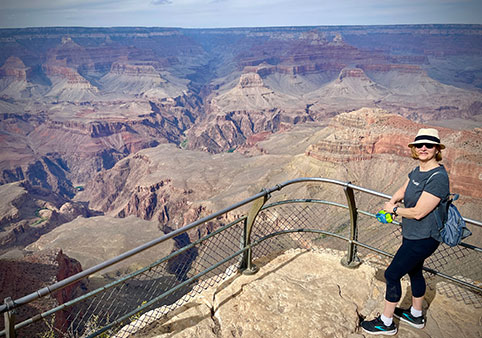
The Trail of Time follows one of the most scenic sections of the South Rim, connecting overlooks with geology exhibits that explain the canyon's formation. Visitors encounter polished rock samples, interpretive displays, and dramatic viewpoints where the lessons immediately come to life.
Rock Layers You Can Identify
Many of the canyon's best-known rock formations can be identified directly from the trail. The exhibits explain how younger sedimentary rocks near the rim gradually transition into much older rocks deep within the Inner Gorge.
For visitors wanting to learn more, our guide to the Grand Canyon Rock Layers explores each major formation in greater detail.
Understanding Geologic Time
One of the trail's greatest strengths is helping visitors appreciate the immense scale of geological time. Human history occupies only a tiny fraction of the timeline represented beneath your feet, while the canyon itself preserves evidence of environments that existed hundreds of millions of years before people appeared.
How Can You Get the Most From Your Visit?
Because the Trail of Time follows the mostly paved Rim Trail, it is suitable for many visitors and can easily be combined with other South Rim destinations. Allow extra time to read the interpretive displays rather than simply walking between viewpoints.
Morning and late afternoon often provide the most comfortable conditions for walking while also producing excellent lighting that makes the canyon's rock layers easier to distinguish.
If you're visiting with children, encourage them to look for the time markers and compare the ages of different rock samples. The trail was designed to make complex geology accessible to visitors of all ages.
Frequently Asked Questions
How long is the Trail of Time?
The interpretive section extends along approximately 1.8 miles (2.9 km) of the South Rim between Yavapai Geology Museum and Verkamp's Visitor Center.
Is the Trail of Time difficult?
No. The trail follows a mostly paved section of the Rim Trail and is considered one of the easiest walks in Grand Canyon National Park.
What is the purpose of the Trail of Time?
It helps visitors understand Grand Canyon geology by connecting rock layers, exhibits, and scenic viewpoints through an easy-to-follow timeline of Earth's history.
Is the Trail of Time good for children?
Yes. The outdoor exhibits, rock samples, and timeline markers make geology easier for visitors of all ages to understand.
Do I need to know geology first?
No. The exhibits are designed for everyone, regardless of scientific background.
Can I visit the Trail of Time without hiking into the canyon?
Yes. The Trail of Time remains on the South Rim and does not descend below the rim.
Continue Exploring Grand Canyon Geology
The Trail of Time offers one of the best introductions to the Grand Canyon's geological story. Continue exploring the landscapes and processes that shaped one of the world's greatest natural wonders.