The Grand Canyon is often described as one of the world's greatest geological wonders, but what makes it remarkable isn't simply its size. The canyon exposes nearly two billion years of Earth's history in a series of colorful rock layers that record ancient oceans, deserts, rivers, beaches, swamps, and mountain-building events. Few places on Earth reveal such an extraordinary span of geological time so clearly.
Whether you're standing at Mather Point, exploring the Trail of Time, or studying the colorful cliffs from Moran Point, you're looking into one of the planet's most complete geological records. This guide explains how the Grand Canyon formed, what the different rock layers represent, and where to see the park's most impressive geological features.
Grand Canyon Geology at a Glance
| Feature | Details |
|---|---|
| Age of the Oldest Rocks | Approximately 1.7 to 1.8 billion years |
| Age of the Youngest Rim Rocks | Approximately 270 million years |
| Primary Sculptor | The Colorado River and millions of years of erosion |
| Visible Rock Layers | More than 40 major sedimentary and metamorphic units |
| Best Geology Viewpoint | Moran Point |
| Best Geology Museum | Yavapai Geology Museum |
| Best Geology Walk | Trail of Time |
| Best Colorado River Geology | Lipan Point |
Why the Grand Canyon Is Geologically Unique
Many canyons are deep. Others are colorful. The Grand Canyon is extraordinary because it combines immense scale with an exceptionally complete geological record. Standing on the South Rim, visitors can literally look backward through hundreds of millions of years as the rock layers descend toward the Colorado River.
Each layer represents a different environment that once existed here. At various times this region was covered by shallow tropical seas, vast coastal plains, towering sand dunes, muddy river systems, and lush swamps. Later, uplift raised the Colorado Plateau thousands of feet before the Colorado River and countless tributaries slowly carved the landscape we see today.
How the Grand Canyon Formed
The Grand Canyon did not appear because of a single event. Instead, it formed through several major geological processes working over immense periods of time.
| Stage | What Happened |
|---|---|
| Ancient Rock Formation | Volcanic activity and mountain building created the oldest basement rocks. |
| Sedimentary Deposition | Layers of limestone, sandstone, shale, and other sediments accumulated over hundreds of millions of years. |
| Colorado Plateau Uplift | The entire region gradually rose thousands of feet above sea level. |
| Colorado River Incision | The river cut downward while tributaries widened the canyon. |
| Continuing Erosion | Rain, snow, freeze-thaw cycles, landslides, and gravity continue reshaping the canyon today. |
The Colorado River's Role
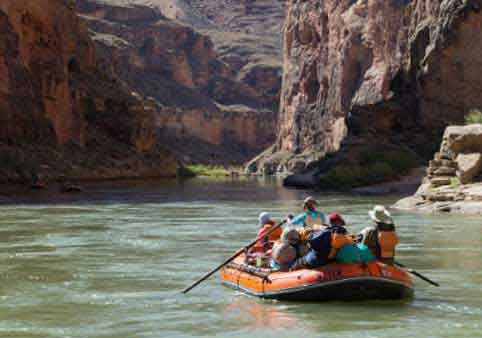
Although the Colorado River is often credited with creating the Grand Canyon, the river is only one part of the story. The river carved downward through the uplifted Colorado Plateau, but rainfall, seasonal flooding, frost wedging, rockfalls, and countless side canyons have widened and continually reshaped the canyon over millions of years.
Today, the Colorado River continues carrying sediment toward the Gulf of California while the canyon slowly evolves through natural erosion.
Reading the Rock Layers
One of the easiest ways to understand Grand Canyon geology is to imagine the canyon as a history book. The youngest chapters are found at the rim, while the oldest chapters lie near the Colorado River far below.
As you look downward from the South Rim, each color change often marks a different rock formation deposited in a completely different ancient environment.
The Major Rock Layers
| Formation | Approximate Age | Ancient Environment |
|---|---|---|
| Kaibab Limestone | ~270 million years | Warm shallow sea |
| Toroweap Formation | ~273 million years | Coastal shoreline |
| Coconino Sandstone | ~275 million years | Ancient desert sand dunes |
| Hermit Formation | ~280 million years | River floodplains |
| Supai Group | ~285 to 315 million years | Coastal plains and rivers |
| Redwall Limestone | ~340 million years | Tropical sea |
| Bright Angel Shale | ~515 million years | Shallow marine environment |
| Tapeats Sandstone | ~525 million years | Ancient beach |
| Vishnu Basement Rocks | 1.7 to 1.8 billion years | Ancient mountain roots and volcanic rocks |
Where to See the Best Geology
Every overlook tells a slightly different geological story. Some emphasize colorful sedimentary layers, while others reveal the Inner Gorge, the Colorado River, or dramatic fault lines.
| Location | Why Visit |
|---|---|
| Moran Point | The best overview of Grand Canyon rock layers and faulting. |
| Yavapai Point | Outstanding geology exhibits and broad canyon views. |
| Trail of Time | Walk through nearly two billion years of Earth's history. |
| Lipan Point | Colorado River, Inner Gorge, and deep canyon geology. |
| Grandview Point | Excellent panoramic view of multiple formations. |
The Great Unconformity
One of the Grand Canyon's most fascinating geological features is something that is missing rather than present. Known as the Great Unconformity, this boundary separates much older basement rocks from significantly younger sedimentary layers, representing a gap of more than one billion years in Earth's geologic record.
Imagine removing several chapters from the middle of a history book. The pages before and after remain, but an enormous span of time has disappeared. That's exactly what geologists see in portions of the Grand Canyon.
The best places to observe evidence of the Great Unconformity include Trail of Time, Yavapai Point, and Moran Point, where interpretive exhibits help explain this remarkable gap in Earth's history.
Why the Canyon Has So Many Colors
The Grand Canyon's spectacular colors come from minerals within the rocks and how those rocks weather over time. Iron creates many of the reds, oranges, and browns that visitors associate with the canyon, while limestone often appears light gray or cream. Different lighting conditions throughout the day further enhance these natural colors.
| Color | Common Cause |
|---|---|
| Red | Iron oxide (rust) |
| Orange | Oxidized sandstone and shale |
| White | Limestone and quartz-rich sandstone |
| Gray | Fresh limestone and shale |
| Dark Brown or Black | Ancient metamorphic and volcanic rocks |
| Purple | Mineral-rich shale and shadowed formations |
Where Can You See the Oldest Rocks?
The oldest rocks in Grand Canyon National Park lie deep within the Inner Gorge near the Colorado River. From the South Rim they appear as dark, nearly black formations at the very bottom of the canyon.
Although they can be seen from several overlooks, the best views are found from Lipan Point, Mohave Point, and portions of the South Kaibab Trail.
Why Does the Colorado River Look Different Every Day?
Visitors are often surprised that the Colorado River sometimes appears emerald green, while other days it looks brown or reddish.
River color changes because of sediment, sunlight, seasonal runoff, weather, and the angle at which the light reaches the canyon. After storms, tributaries often carry muddy water into the river, while clear days may produce brilliant green reflections.
Best Places to Learn About Grand Canyon Geology
| Location | Why Visit |
|---|---|
| Yavapai Geology Museum | Excellent exhibits and panoramic windows overlooking the canyon. |
| Trail of Time | A self-guided walk through nearly two billion years of Earth's history. |
| Moran Point | Outstanding view of faults, folds, and layered rock formations. |
| Lipan Point | Exceptional views into the Inner Gorge and Colorado River corridor. |
| Grandview Point | Broad perspective of multiple rock formations across the canyon. |
Common Geology Myths
| Myth | Reality |
|---|---|
| The Colorado River created the entire canyon by itself. | The river carved downward, but weathering, landslides, and tributaries widened the canyon over millions of years. |
| The canyon formed quickly. | Its development required millions of years of uplift and erosion. |
| All the rock layers formed at the same time. | Each layer represents a completely different environment separated by millions of years. |
| The canyon has stopped changing. | Erosion continues every day through water, wind, gravity, and freeze-thaw cycles. |
Geology Tips for Visitors
- Visit Yavapai Geology Museum before exploring viewpoints.
- Walk the Trail of Time for the easiest introduction to Grand Canyon geology.
- Bring binoculars to distinguish individual rock layers.
- Visit both morning and afternoon to see how changing light reveals different formations.
- Don't focus only on the horizon. Some of the oldest rocks are directly below the rim.
- Take your time. Understanding the canyon becomes easier after visiting several viewpoints.
Frequently Asked Questions
How old is the Grand Canyon?
The rocks exposed within the Grand Canyon range from about 270 million years old at the rim to nearly 1.8 billion years old in the Inner Gorge. The canyon itself formed much more recently as the Colorado River and erosion carved through those ancient rocks over millions of years.
Did the Colorado River create the Grand Canyon?
The Colorado River played the leading role in carving the canyon, but it did not work alone. Rain, snow, tributary streams, rockfalls, landslides, and freeze-thaw cycles all continue to shape the canyon today.
Why are the rock layers different colors?
Different minerals produce different colors. Iron creates many of the reds and oranges, limestone often appears gray or cream, and weathering changes how the rocks reflect sunlight throughout the day.
Where can I see the oldest rocks?
The oldest rocks are found deep within the Inner Gorge near the Colorado River. Excellent viewpoints include Lipan Point, Mohave Point, and portions of the South Kaibab Trail.
What is the Great Unconformity?
The Great Unconformity is a boundary separating ancient basement rocks from much younger sedimentary layers. It represents more than one billion years of missing geologic history, making it one of the most famous geological features in North America.
Which viewpoint is best for understanding Grand Canyon geology?
Moran Point is often considered the best single overlook for interpreting rock layers, faults, and the canyon's geologic history. Yavapai Point and the Trail of Time are also outstanding educational stops.
Can you see fossils at the Grand Canyon?
Yes. Fossils occur in several sedimentary rock layers throughout the canyon, especially in limestone formations. However, collecting fossils or rocks inside Grand Canyon National Park is prohibited.
Is the Grand Canyon still changing?
Absolutely. Every year, erosion, rockfalls, flash floods, and weather continue to reshape the canyon. Although the changes are usually subtle, the landscape is far from static.
The GrandCanyon.net Geology Scorecard
| Experience | Best Location |
|---|---|
| Overall Geology | Moran Point |
| Interpretive Exhibits | Yavapai Geology Museum |
| Self-Guided Learning | Trail of Time |
| Colorado River Geology | Lipan Point |
| Ancient Basement Rocks | Mohave Point and South Kaibab Trail |
| Rock Layer Identification | Grandview Point |
| Educational Value | ★★★★★ |
Our Recommended Geology Itinerary
Stop 1
Begin at Yavapai Geology Museum to understand the major rock formations before visiting the overlooks.
Stop 2
Walk a portion of the Trail of Time to visualize nearly two billion years of Earth's history.
Stop 3
Drive to Moran Point to identify the canyon's colorful rock layers and major faults.
Stop 4
Continue to Lipan Point for views into the Inner Gorge and the Colorado River.
Finish
End at Desert View Watchtower, where you can appreciate how Mary Colter designed the structure to complement the surrounding geology.
Continue Exploring Grand Canyon Geology
Once you understand the canyon's geology, every viewpoint becomes more meaningful. Continue exploring these guides to see how different overlooks reveal unique chapters of the Grand Canyon's remarkable geological story.
Best Grand Canyon Viewpoints »